
Rigorous customer experience measurement is built, not bought.

What is the HCD Measurement Guide?
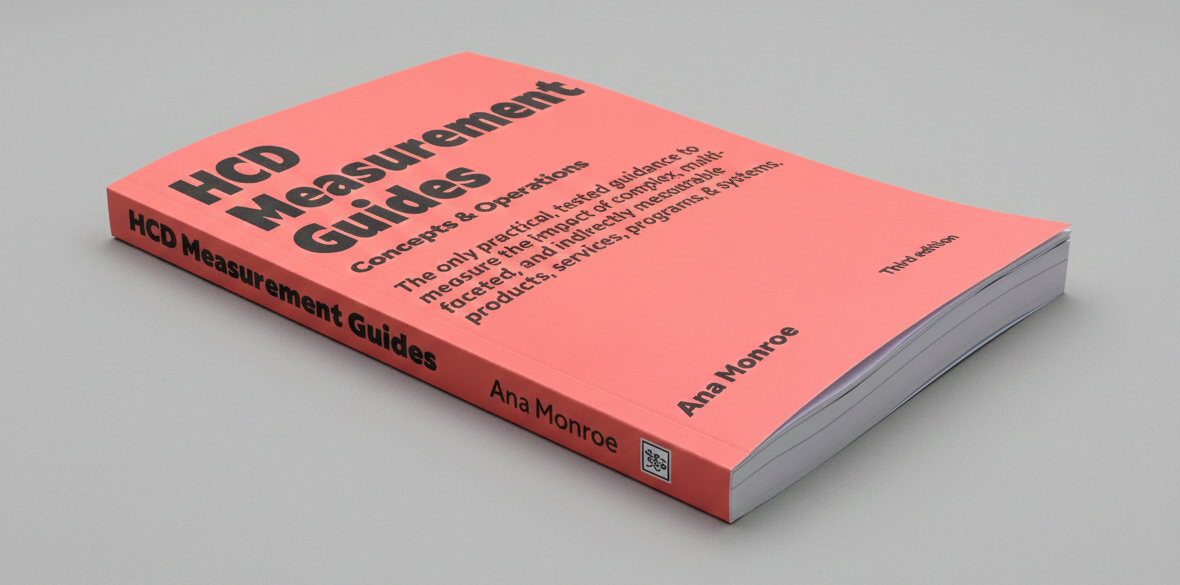
The HCD Measurement Guide shows you how to measure complex, indirectly measurable phenomena - customer experience, engagement, trust, satisfaction - moving beyond flat backward-looking metrics like visitor counts and Likert scores.
The Measurement Guide gives you the frameworks data scientists use but translated for professionals who need to prove impact in contexts where all variables can't be controlled.
The HCD Measurement Guide is based on a directly references the work of:
- Organisation for Economic Co-operation and Development (OECD)
- U.S. National Science Foundation (NSF, pre-2025)
- U.S. Agency for International Development (USAID, pre-2025)
- United Nations Economic Commission for Europe (UNECE)
- The work of various European Union national statistics offices

How is the HCD Measurement Guide better than other processes?
Unlike analytics dashboards that give you numbers without meaning or evaluation frameworks that require lab conditions you'll never have, the Measurement Guide bridges the gap between messy real-world work and evidence-backed, significant measurement.
The Measurement Guide was written with input from data and evaluation scientists to ensure the methodology's rigor and impact.
Your measurement instruments also ready you to approach data scientists with data portfolios that actually align with how those professionals work, so you can finally have productive conversations about statistically significant impact measurement.
Why is the HCD Measurement Guide critical to my success?
You know your work creates value but you're stuck defending it with metrics that don't capture what actually matters - so leadership sees cost, not impact.
The Measurement Guide gives you the systematic approach to building measurement that shows the larger context your work influences, turning "we think this helps" into "here's the evidence that this changed how our system works."
The HCD Measurement Guide is systematic impact measurement.
The HCD Measurement Guide provides the comprehensive customer experience measurement methodology for people who need to prove impact without controlling all variables.
This systematic framework guides researchers, designers, engineers, and product managers through implementing compiled indicators, an accessible approach to measuring complex outcomes like trust, engagement, and satisfaction.
The methodology uses straightforward computational methods rather than statistical modeling, making rigorous CX measurement accessible to professionals without advanced data science training. It is based on data science work by major institutions including OECD, USAID, UNECE, and the European Union's Eurostat.
The guide has been used by federal agencies including the General Services Administration and taught at the Ohio State University to measure the effectiveness and evolution of customer experience initiatives.
What's up with "human centered" versus "human-centered"?
You caught it! And we can explain.
"Human-centered" is grammatically correct—the hyphen creates a compound adjective that modifies "design." We use it in all our formal content and teaching materials. However, search data shows that people most often search for "human centered" (no hyphen) when looking for methodology guidance.
Since our goal is to make this research-backed framework accessible to the people who need it, we've optimized key pages for both spellings. You'll see the hyphenated version in our actual content and the non-hyphenated version in select page titles and metadata.

HCD Guide Series
Get all four HCD Guides: Discovery, Production, Delivery, and Measurement, and drop into where ever you find yourself in your innovation or process improvement cycle.
*More than 10% off buying the Guides individually!